As Founding Product Designer, I shaped an AI-powered generative roguelike card game, turning complex systems into intuitive, rewarding player experiences.

CHALLENGE
How do you make infinite, AI-generated creatures feel coherent, collectible, and strategic, without overwhelming the player? How does a gameplay incorporates an infinite generated content?
STRATEGY
Design a readable system that teaches itself. Build a visual language so consistent that every new creature, ability, and battle can be understood at a glance.
SOLUTION
Created an intelligent modular UI system linking visual form to gameplay function, built WebGL prototypes and AI supported components Defined clear interaction states and rich animations & transitions Designed AI-integrated metadata tags (type, rarity, origin) to visually scale infinite content for infinite card combinations
RESULTS
🧭 Comprehension 4× faster player understanding in tests ⚡ Retention 2× longer average session duration 💎 Scalability Design system reduced UI rework by ~40% 🎮 Player Feedback Described as “strategic, clear, and alive”

Generative AI powered every creature, combining LLM-generated descriptions, style-conditioned artwork, and procedural stats into thousands of unique outcomes.


I introduced semantic design rules that mapped AI-generated names, abilities, and lore to a consistent visual language. Procedural stats were communicated through colour, icons, and motion, creating endless variety within a clear, predictable player experience.


The Card State System I designed a unified card state system that uses motion to communicate function, timing, and emotion. Rather than relying on text, players learn through rhythm, creating gameplay that feels intuitive rather than mechanical.



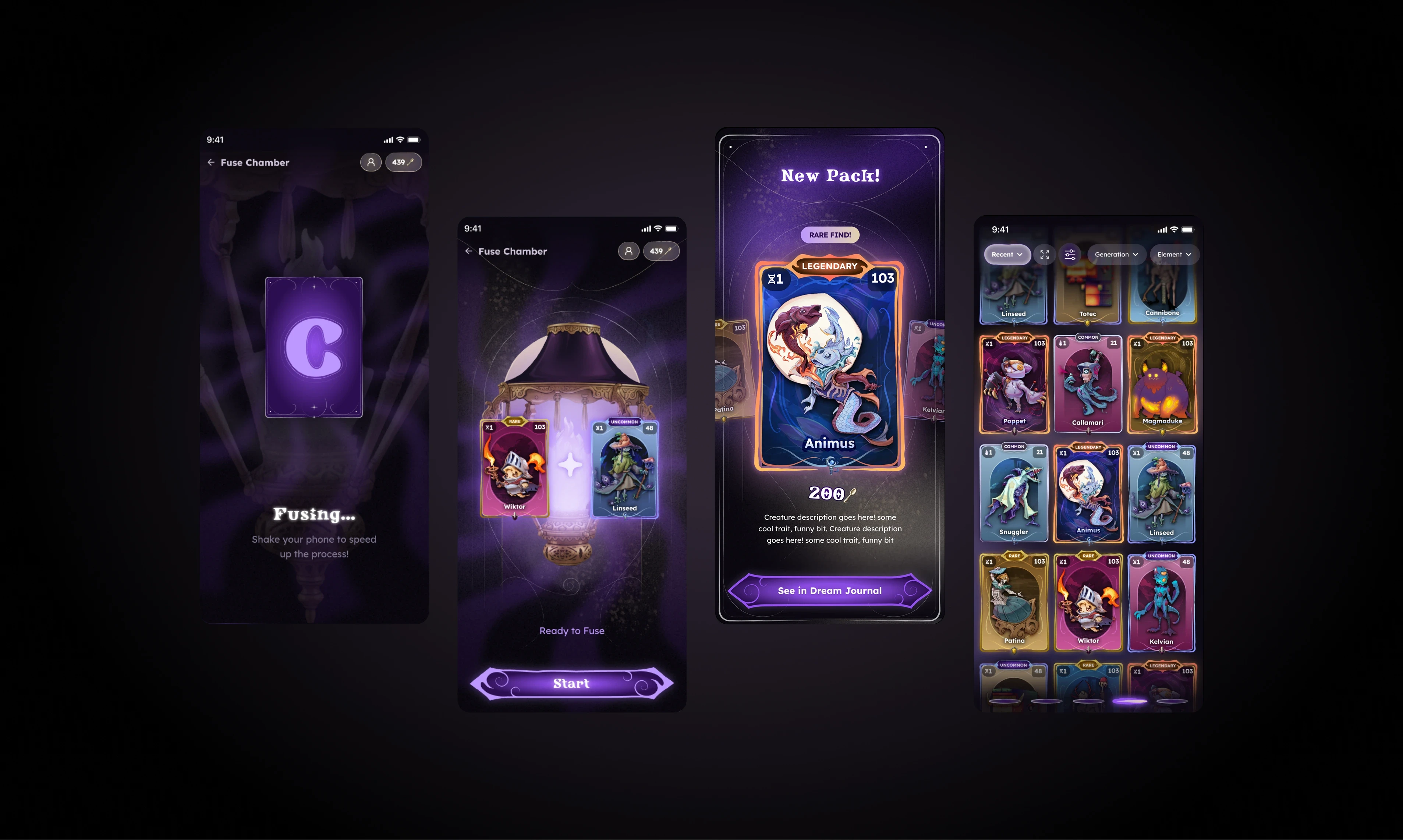

Every interaction teaches through feedback. Motion, microinteractions, and visual cues communicate actions, direction, and cooldowns, allowing players to understand the game naturally—without tutorials.

The prototype coded in WebGL to test and develop the right interactions, transitions and VFX.


Design Foundations
I built a scalable UI system inspired by leading TCGs, adapting readability patterns for AI-generated content. Typography, iconography, and colour respond dynamically to procedural data, balancing AI generation with human-led design.


Final Thoughts Designing for generative systems isn’t about control—it’s about orchestration. Elsewhere Creatures showed how interface design can turn infinite AI output into a cohesive, legible, and joyful experience. Clarity becomes the true form of creativity. Tools: Figma · Framer · Calvary · After Effects · GitHub · Cursor Design & Product Strategy — Agata Inventio Game Direction — Elsewhere Team Art & Illustration — Elsewhere Studio Artist